
“Grand Rapids SC” — The Century-Old Name That Stuck
By Grand Rapids Soccer Club, Special to the West Michigan Soccer Community December 2025
Soccer in Grand Rapids isn't just a game—it's a thread woven into the fabric of our city's history, from the makeshift pitches of immigrant laborers in the early 20th century, to the gleaming lights of the soon-to-open Amway Stadium. For over a century, this riverside city has nurtured a passion for the beautiful game, often through grassroots efforts that prioritized community over glory. Today, that spirit lives on in Grand Rapids Soccer Club (GRSC). As GRSC prepares to take the field in the Midwest Premier League in 2026, it's worth reflecting on the rich tapestry of soccer in Grand Rapids—and how our club stands as its proud continuation.
The Immigrant’s Game: Soccer's Quiet Arrival (Late 1800s–1920s)
Grand Rapids' story as a soccer town begins with waves of European immigrants who arrived in the late 19th century, drawn by the lumber boom and flourishing furniture industry. Dutch, Polish, German, and Scandinavian workers brought with them a love for voetbal, piłka nożna, and Fußball—simple games played on makeshift pitches amid the sawmills and factories along the Grand River. These weren't polished leagues but raw, communal outlets for recreation after grueling shifts.
In the late 19th century, both “Association Football” (often shortened to “soccer” in Britain) and “Rugby Football” were commonly distinguished by nicknames. In the United States, a variant of rugby evolved into the distinct sport of gridiron football, which Americans simply called “football.” Over the course of the 20th century, “soccer” gradually fell out of everyday use in Britain (where Association Football claimed the unqualified name “football”), while it remained the standard term in the U.S. and a few other countries.
Throughout the early 1900s, soccer games at John Ball Park, Houseman Park, Garfield Park, and Ramona Park grew to have enormous amounts of spectators, with articles stating attendance in the thousands for local immigrant matches. The first major soccer football match was in East Grand Rapids in 1913, at what was then called Ramona Park (now Memorial Field). The match featured The Royal Sons of St. George, a team made of up of mostly English and Scottish players, versus the Peninsulars, a team of Detroit-based all-stars. Following the game, interest began to grow around forming a local team to represent the city of Grand Rapids.
In 1914, Grand Rapids Schools’ Superintendent, William A. Greeson considered proposing changes to the board of education to eliminate American Football from high school athletics, promoting soccer as the alternative. American Football at the time was extremely dangerous due to inadequate head protection, while soccer’s high stamina requirements were believed to be effective in preparing young men for the military. In the years following, high schools would attempt to establish soccer as a “major county sport” with Cedar Springs, Rockford and Grand Rapids South, Central, Union, and Junior High Schools leading the effort. These schools made up a league that included Plainfield, Coldbrook, Diamond, and dozens of other neighborhood high schools. By 1917, over 800 players were playing in this high school league.
During the 1920s, informal groups coalesced into what locals simply called "soccer clubs." These entities took many names sandwiched between “Grand Rapids” and “Soccer Club”; Nationals, Americans, Germania, Independent, and Vikings, to name a few. The teams played in the Western Michigan Soccer League, which was more casually named the Soccer Loop. There were so many of these closely named clubs, that when a Grand Rapids club would leave town to play a match, the newspapers of those towns would refer to them as “the Grand Rapids soccer club”. The 1930s brought a flicker of international recognition when Paul Esenwein of Grand Rapids Sport Club was selected as the only West Michigan representative on DSV Germania—a U.S. all-star squad of German-American players that toured Europe. Facing today's Bundesliga giants, Esenwein helped secure a 2–1 upset over Hannover 96 and scored in a 3–1 win against Minerva Berlin, though the team fell 4–0 to Eintracht Frankfurt and suffered other setbacks [2]. His inclusion on this landmark tour—only the fourth American soccer delegation to Europe—put the name Grand Rapids SC on the international map, with the Milwaukee Herold honoring him at a farewell banquet alongside Milwaukee and Chicago stars [2].
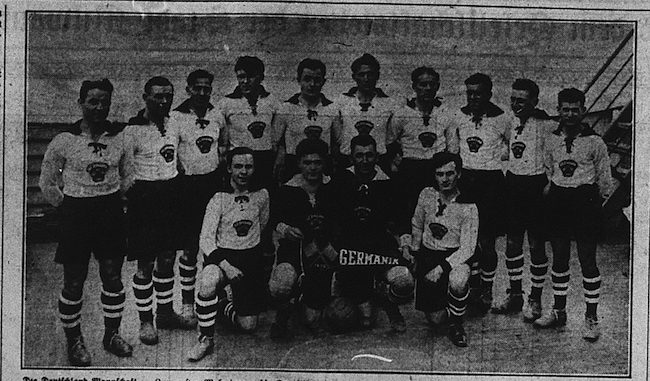
The 1930 DSV Germania team. Paul Esenwein (Grand Rapids Sport Club, top row, 4th from left). From Milwaukee Herold, June 1, 1930.
By 1930, The Grand Rapids Press had fully embraced soccer, sponsoring a season-long tournament called The Press Cup. The Americans traditionally won this trophy, led by Joe Egner, who oversaw the merger of the Nationals and the Americans into the Grand Rapids Independent Soccer Club a few years later. Every Christmas after the club’s founding, Egner’s players would visit him at his East Grand Rapids home, 654 Croswell Ave SE..
This period laid the groundwork for organized play, with the Michigan Soccer Football Association forming in 1929 to oversee amateur leagues across the state.
Post-War Boom: From Backlots to Backyards (1940s–1970s)
World War II accelerated soccer's foothold as returning veterans and displaced Europeans introduced the sport to a new generation. In Grand Rapids, the Catholic Youth Organization (CYO) and public schools like Ottawa Hills High began intramural leagues, while factory teams evolved into semi-structured adult squads.
The 1950s baby boom supercharged youth involvement. By the 1960s, fields at Reeds Lake and Richmond Park buzzed with kids' games under the nascent Michigan Youth Soccer Association (MYSA, formalized in 1974). In the late 1950s, competitive soccer began to hit the papers again, with new teams like Grand Rapids Comets SC, Grand Rapids Olympics SC, Grand Rapids Be-Quicks SC and more.
Title IX in 1972 opened doors for girls' programs, and local colleges jumped in: Western Michigan University elevated its men's team to varsity in 1971, fostering rivalries that echoed the old neighborhood scraps [3]. Ethnic clubs in Holland and Grand Rapids' Reformed communities emphasized discipline and development, turning pickup games into pathways for talent.
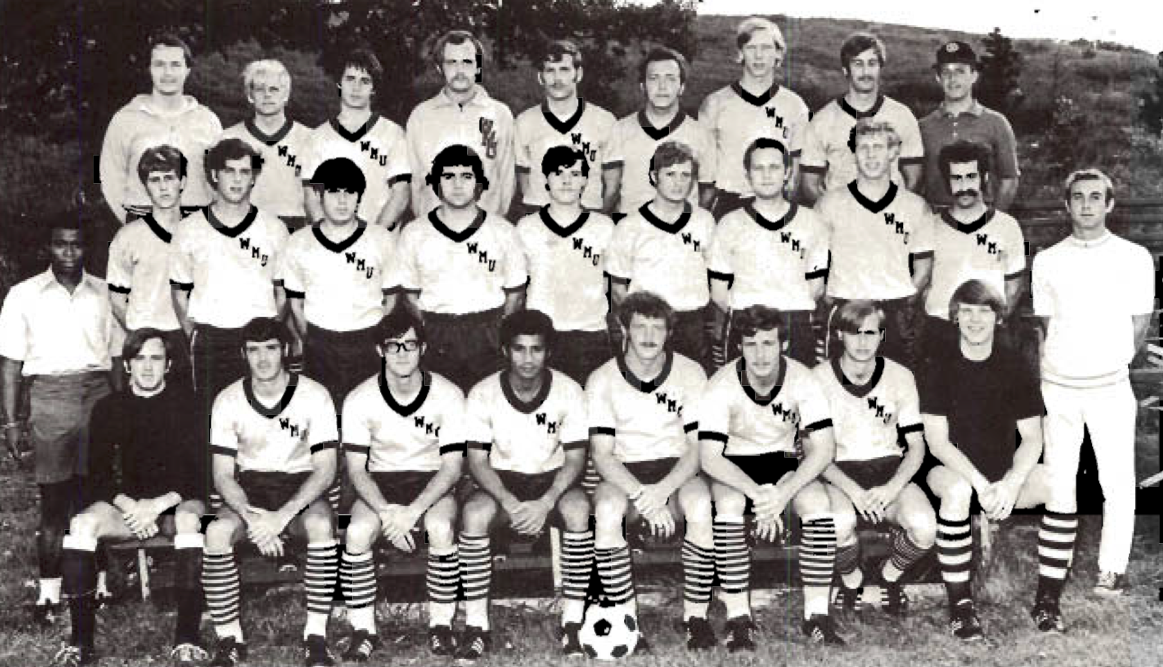
Western Michigan University Broncos’ Varsity Soccer Team, 1972
The Competitive Dawn: Youth Powerhouses and Semi-Pro Dreams (1980s–2020s)
The 1980s marked soccer's leap from sideline hobby to serious pursuit, fueled by the North American Soccer League's national buzz (hello Pele) and the 1994 World Cup hosted on U.S. soil. In Grand Rapids, this ignited a youth explosion: AYSO chapters in Kent County enrolled thousands, while select clubs transformed AYSO squads into elite programs competing in the Grand Valley Soccer Association and Michigan State Premier Soccer Program (MSPSP) [4, 5].
Adult leagues flourished too, with the West Michigan Soccer League boasting 20+ teams by the 2000s. Youth clubs built sprawling complexes for youth development and club expansion. Grand Rapids began to see homegrown players making their way into the professional game.
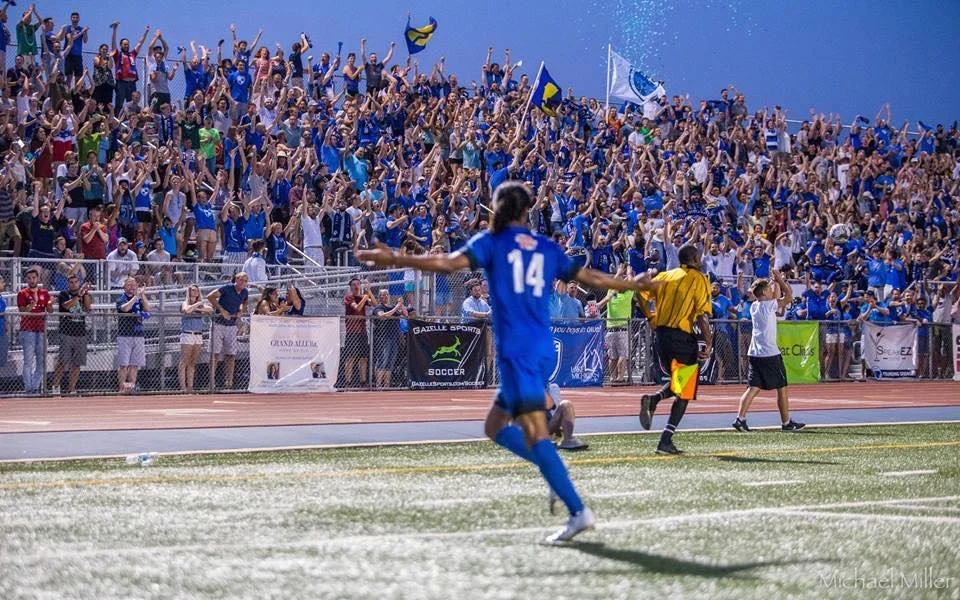
Grand Rapids FC’s Noble Sullivan celebrates after scoring a goal, 2016
The pinnacle arrived in 2014 with Grand Rapids FC (GRFC) of the National Premier Soccer League (NPSL). Born from the grassroots of a flourishing semi-professional scene in Michigan, GRFC packed Houseman Field with 3,000+ fans per match, clinched the 2015 NPSL Midwest Conference, and saw its women's team claim the 2017 United Women's Soccer national championship in their debut season [6, 7]. Though GRFC folded in 2021 amid venue woes and the pandemic, its legacy of community-driven fervor directly inspired today's professional ambitions—and the revival of the historic Grand Rapids SC name.
The present day GRSC was founded in 2023, acquiring talent from local youth programs and securing third place in the United Premier Soccer League's Fall 2024 season before joining the Midwest Premier League [8, 9]. Playing in the historic East Grand Rapids, once Ramona Park, GRSC isn't just a team—it's the direct heir to the GRSC of the early 1900s. Our crest, which honors the Grand River and La Grande Vitesse sculpture, embodies that continuity: community-led, resilient, and ready to inspire the next wave of players and fans [8].
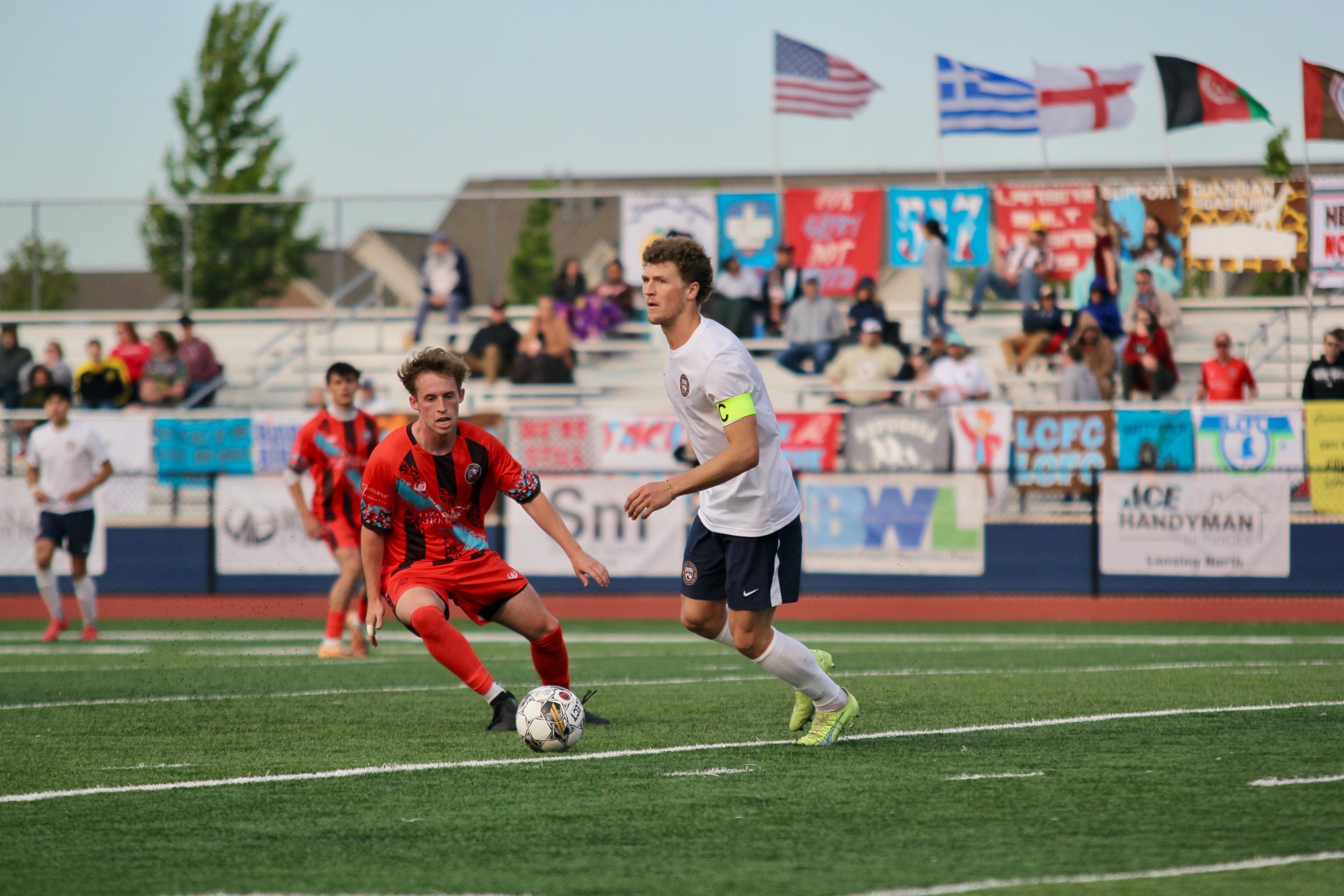
GRSC Captain Ethan Jansen looks ahead for a pass against Lansing Common FC on May 31, 2025.
With over 25,000 youth players today, Grand Rapids is poised as a Midwest region soccer hub [10]. GRSC stands at the crossroads, offering potential professional pathways while keeping the game accessible.
For tickets, tryouts, or to learn more about GRSC's community programs, visit grandrapidssc.com. Follow us on Instagram and X @GrandRapidsSC for match updates and history deep-dives.
Sources:
Newspapers.com, 1850-1940 soccer archives. View collected content.
“DSV Germania: The 1930 Deutschamerikaner Tour,” Society for American Soccer History, ussoccerhistory.org/dsv-germania-the-1930-deutschamerikaner-tour.
Western Michigan University Athletics archives.
Rapids FC history page (rapidsfc.com/history).
Michigan State Premier Soccer Program records.
Grand Rapids FC Wikipedia & NPSL archives.
United Women's Soccer 2017 championship report.
Grand Rapids SC official site (grandrapidssc.com).
United Premier Soccer League Fall 2024 standings.
Michigan Youth Soccer Association participation reports.
